Ultrasonic systems are routinely equipped with heaters equal to only 50% of the
required wattage because ultrasonic transducers generate significant heat. Typically a tank
equipped with a 500-watt heater and 500 watts transducers outputs roughly 1000 watts of heat.
Even when at temperature this ultrasonic system will generate roughly 500 watts of unwanted
heat. Because of this ultrasonic tanks frequently overheat causing FDM parts to warp and
delaminate. CleanStation® SRSTM systems incorporate computer controlled heating elements with
both active and passive cooling techniques to maintain the WaterWorksTM soluble concentrate
solution temperature to within 1/10 of a degree of its optimal temperature level.
Whenever the soluble concentrate solution is replaced or re-freshed dissolved gas in
the solution will cause ultrasonic systems to produce a severe harmonic 'squeal', at
potentially harmful sound levels, until the solution has 'de-gassed'. This process can take
what seems like hours for larger systems. Even during normal operation these systems are
easily loud enough to make ear protection mandatory. As the adoption of ultrasonic technology
has spread, workers claiming to have suffered permanent nerve damage and hearing loss have
initiated numerous lawsuits. Given the current legal environment of business there is no
reason to believe that these actions will not continue to proliferate
WaterWorksTM soluble concentrate is heavier than water and is prone to merely settle
at the bottom of the tank leading to excessively long post-process times and incomplete support
removal. Ultrasonic sound waves generate mechanical force only through cavitation. Cavitation
alone is incapable of producing enough agitation to thoroughly mix the soluble concentrate.
In fact agitation sufficient to mix the soluble concentrate creates enough turbulence to
disrupt ultrasonic emissions thus rendering the technology entirely useless. "Agitation"
systems offered by ultrasonic manufacturers consist only of a gentle 1 or 2 inch vertical
oscillation of the part every 4 seconds. This is insufficient to mix the soluble concentrate
or strip away support material.
Ultrasonic cleaning systems are efficient for the surface cleaning of metals and
metallic components but far less so for plastics. All plastics and especially softened
WaterWorksTM support material have great capacity to absorb ultrasonic emissions. This makes
ultrasonic systems load sensitive when surface-cleaning WaterWorksTM supported FDM parts. Load
sensitivity means longer batch processing times, more overheating, and more damaged parts.
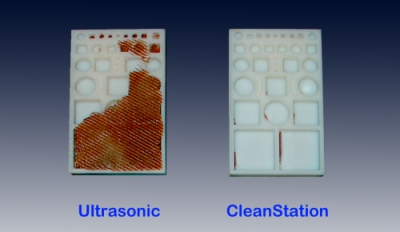
A comparison photo of each type of post-processing over the same amount of time